

U.S. Launches First Direct Military Strikes in Nigeria, Marking Major Shift in Africa Policy
On December 25, 2025, the United States carried out its first known direct military strikes on Nigerian soil, targeting Islamic State (ISIS) camps in Sokoto State in the country’s northwest. The operation represents a significant escalation of U.S. military involvement in West Africa and a pivotal moment in Nigeria’s long-running fight against transnational jihadist groups.
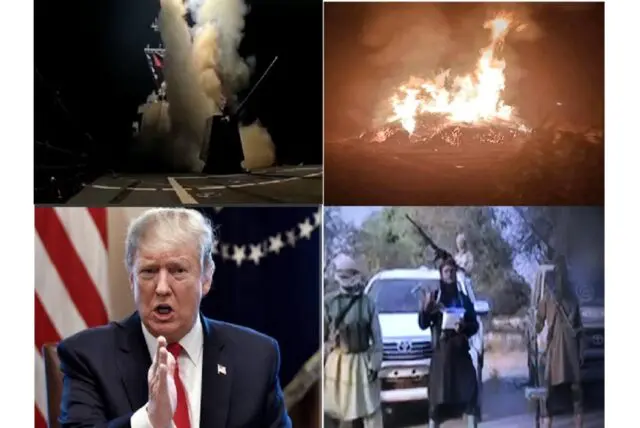
According to defense officials, the strike involved more than a dozen Tomahawk cruise missiles launched from a U.S. Navy vessel positioned in the Gulf of Guinea. The mission was authorized by President Donald Trump, signaling what analysts describe as a “significant intervention point” in U.S.–Nigeria security cooperation.
A Shift Toward Targeted Military Action
Security analysts view the operation as a concrete application of the Trump administration’s “America First” doctrine in Africa—favoring limited, high-impact military interventions over long-term nation-building or peacekeeping missions.
Rather than deploying ground forces, the United States opted for precision strikes aimed at dismantling specific ISIS infrastructure believed to be supporting regional operations tied to ISIS-Sahel. The strikes targeted training camps and logistical hubs in areas where militant influence has expanded rapidly over the past year.
Religious and Political Dimensions
President Trump and Secretary of War Pete Hegseth framed the strikes as a direct response to what they described as the “vicious killing” and “genocide” of innocent Christians in northern Nigeria. The administration emphasized that the decision to act was driven by the protection of persecuted civilians.
The Nigerian government, while confirming it approved the operation, rejected characterizations of the conflict as primarily religious. Officials in Abuja stated the strikes were aimed at protecting all Nigerians from the growing threat of transnational terrorism, regardless of faith.
Expanding Militant Threat in Northwestern Nigeria
The strikes focused on Nigeria’s northwest, a region increasingly destabilized by the emergence of Lakurawa, a relatively new militant group believed to be aligning with or merging into ISIS-Sahel networks. Analysts warn this convergence risks linking Nigeria’s internal security crisis with the broader Sahel insurgency, creating a continuous arc of instability from Mali to northern Nigeria.
U.S. and Nigerian intelligence agencies reportedly engaged in extensive intelligence sharing ahead of the strikes, despite past diplomatic frictions over sovereignty and military coordination.
More Strikes Likely
U.S. defense officials cautioned that the Christmas Day operation may not be a one-off. Statements indicating that there is “more to come” suggest the possibility of a sustained U.S. air campaign against ISIS-linked targets in Nigeria, depending on militant responses and Nigerian security assessments.
Symbolism of a Christmas Day Strike
The decision to conduct the operation on Christmas Day carries heavy symbolic weight. For the Trump administration, the timing reinforces its narrative of intervening to protect Christians during one of their most sacred holidays. Critics, however, warn the symbolism could inflame sectarian tensions if not carefully managed.
Regional and Global Implications
The strikes underscore a broader U.S. willingness to directly confront ISIS affiliates beyond traditional battlefields, while highlighting Nigeria’s growing role as a front line in the global fight against jihadist terrorism. How sustained the U.S. commitment will be—and how it reshapes security dynamics in West Africa—remains to be seen.
By Staff Reporter