

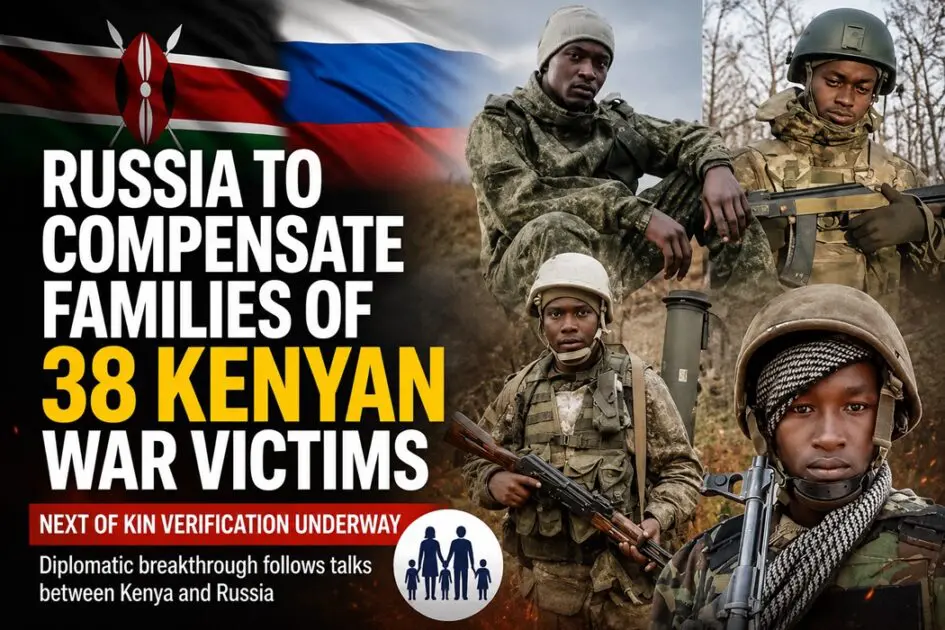
Russia Begins Compensation Process for Families of 38 Kenyan War Victims
The Russian government has initiated the process of identifying and compensating the families of 38 Kenyan nationals who were either killed or declared Missing in Action (MIA) while fighting in the ongoing Russia-Ukraine war.
The development follows diplomatic engagements between Kenya and Russia and marks one of the first formal efforts to provide financial compensation to Kenyan families affected by the conflict.
According to information shared through Kenya’s State Department for Diaspora Affairs, the affected families are receiving assistance from the Kenyan Embassy in Moscow as authorities work to verify next-of-kin information before compensation is released.
Diplomatic Talks Led to Compensation Agreement
The compensation arrangement reportedly emerged following official discussions between Prime Cabinet Secretary and Cabinet Secretary for Foreign and Diaspora Affairs Musalia Mudavadi and Russian Foreign Minister Sergey Lavrov.
Under the agreement:
- Russia will compensate the families of 38 Kenyan victims.
- Payments will be made directly to legally recognized family representatives.
- Kenyan authorities are assisting in collecting and verifying beneficiary information.
- The Kenyan Embassy in Moscow is coordinating communication with Russian officials.
Officials say verifying the rightful beneficiaries is critical to ensure the compensation reaches the intended recipients without delays or disputes.
How the Compensation Process Will Work
Russian authorities have requested Kenya’s State Department for Diaspora Affairs to compile and verify detailed records for each victim.
The required information includes:
- Full names of the deceased or missing individuals.
- Identity documents.
- Verified next-of-kin details.
- Legal documentation identifying the authorized family representative.
- Banking and payment verification where required.
Once verification is completed, Russian authorities are expected to transfer compensation directly to the approved beneficiaries.
Many Kenyans Were Recruited Through Private Channels
Many of the affected Kenyans are believed to have entered Russia through private recruitment agencies, security firms, or employment offers that allegedly promised well-paying jobs.
Some later found themselves deployed to active combat zones after signing contracts whose full implications they may not have fully understood.
Others were reportedly recruited while already residing in Russia or neighboring countries before joining military operations.
The Kenyan government has repeatedly emphasized that these individuals were not deployed by Kenya’s military and did not serve as members of the Kenya Defence Forces.
Kenyan Diaspora Impact
The case has sent shockwaves throughout Kenyan diaspora communities across Europe, North America, and the Middle East.
Diaspora organizations say the tragedy underscores the growing vulnerability of young Kenyans seeking employment abroad amid rising unemployment and economic hardship.
Community leaders are urging Kenyans considering overseas employment to:
- Verify recruitment agencies.
- Confirm employment contracts with Kenyan diplomatic missions.
- Avoid offers involving military or conflict-zone assignments.
- Register with Kenyan embassies after relocating abroad.
Families have also called for increased government support for Kenyans who become stranded, exploited, or caught in armed conflicts overseas.
Immigration Implications
The incident raises broader immigration and labor migration concerns.
Migration experts warn that desperate job seekers are increasingly becoming targets of fraudulent recruiters offering high-paying overseas positions that later expose them to dangerous working environments.
The tragedy reinforces the importance of:
- Using licensed international recruitment agencies.
- Confirming visa categories before travel.
- Reviewing employment contracts with legal professionals.
- Understanding the laws of destination countries.
- Registering with Kenyan diplomatic missions immediately after arrival.
Governments worldwide continue strengthening oversight of international labor recruitment as reports of deceptive overseas employment continue to emerge.
Expert Opinion
Migration and labor experts argue that stronger international cooperation is needed to protect migrant workers from deceptive recruitment.
Experts recommend:
- Enhanced regulation of foreign recruitment agencies.
- Better pre-departure education for migrant workers.
- Improved information sharing between governments.
- Expanded consular protection for citizens abroad.
- Emergency support systems for nationals trapped in conflict zones.
Human rights advocates also emphasize that migrant workers should receive clear information regarding employment risks before leaving their home countries.
Statistics Highlight Growing Global Migration Risks
According to the International Organization for Migration (IOM), hundreds of millions of people currently live outside their country of birth, with labor migration continuing to increase each year.
The United Nations estimates that more than 280 million international migrants live outside their countries of origin worldwide, many relocating in search of employment and better economic opportunities.
While the overwhelming majority migrate safely and legally, international organizations continue warning about the dangers posed by human trafficking networks, labor exploitation, deceptive recruitment practices, and employment in conflict-affected regions.
Families Await Closure
For the families of the 38 Kenyan victims, the compensation process represents more than financial assistance—it is recognition of the difficult circumstances surrounding the loss or disappearance of their loved ones.
Authorities continue encouraging affected families to cooperate with the verification exercise through the State Department for Diaspora Affairs and the Kenyan Embassy in Moscow so that compensation can be processed without unnecessary delays.
The case also serves as a sobering reminder of the risks associated with accepting overseas employment opportunities without thorough verification, particularly in regions experiencing armed conflict.
As Kenya continues expanding labor migration programs around the world, experts say protecting citizens abroad through stronger recruitment oversight and enhanced diplomatic support remains a national priority.