

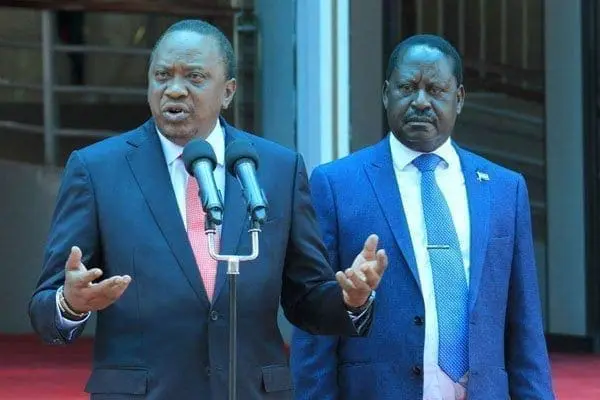
Uhuru Kenyatta, Raila Odinga Among First Presidential Candidates to Declare Wealth to EACC
President Uhuru Kenyatta and opposition leader Raila Odinga are among the first presidential candidates to submit their self-declaration of wealth and integrity forms to the Ethics and Anti-Corruption Commission (EACC) as part of the clearance process for Kenya’s General Election.
The declarations form part of the legal requirements established under Chapter Six of the Constitution and the Leadership and Integrity Act, 2012, aimed at promoting accountability, transparency, and ethical leadership among individuals seeking public office.
According to EACC Chairperson Archbishop (Rtd.) Eliud Wabukala, the Commission will thoroughly examine each candidate’s declaration before determining whether they satisfy the constitutional standards expected of public leaders.
EACC to Verify Information Before Issuing Clearance
Speaking during the launch of a partnership with a faith-based organization, Archbishop Wabukala emphasized that submitting the forms is only the first step.
The Commission will independently verify the information provided by every presidential aspirant to ensure the declarations are truthful and complete before issuing the necessary clearance certificates.
President Kenyatta sought re-election under the Jubilee Party, while Raila Odinga contested the presidency as the flag bearer of the National Super Alliance (NASA) coalition.
The EACC previously announced that all candidates seeking elective office—including governors, senators, MPs, women representatives, MCAs, and presidential aspirants—must complete the self-declaration process before participating in the elections.
What Candidates Must Disclose
The wealth declaration and integrity questionnaire requires aspirants to disclose information relating to their personal conduct, financial accountability, and ethical record.
Among the issues examined are whether a candidate has:
- Engaged in dishonest conduct while serving in public office.
- Abused official authority for personal gain.
- Misrepresented information to the public.
- Misused public funds or government resources.
- Discriminated against others while in office.
- Falsified official or personal records.
- Been removed from a professional body.
- Had a professional or occupational license revoked.
- Been dismissed because of integrity-related concerns.
- Failed to declare income, assets, or liabilities as required by law.
- Been convicted of an offence carrying a prison sentence of six months or more.
- Previously been denied a Certificate of Good Conduct or a visa.
The EACC says these disclosures help determine whether an aspirant meets the integrity standards required of public officials.
Why Wealth Declaration Matters
The self-declaration exercise is one of Kenya’s most significant anti-corruption safeguards. By requiring candidates to publicly account for their wealth and past conduct, authorities aim to strengthen public confidence in elected leaders.
Political analysts argue that transparent disclosure of assets helps deter illicit enrichment and promotes responsible leadership.
Governance experts have consistently noted that effective enforcement of Chapter Six remains essential for combating corruption and improving Kenya’s democratic institutions.
Kenyan Diaspora Impact
For the millions of Kenyans living abroad, the integrity of national leadership extends far beyond domestic politics.
Transparent governance influences:
- Confidence among diaspora investors seeking opportunities in Kenya.
- Government accountability in managing remittances and development projects.
- International confidence that supports bilateral cooperation and foreign investment.
- Delivery of diaspora-focused services through Kenyan embassies and consulates.
- Long-term economic stability that encourages return migration and business expansion.
According to the World Bank, Kenya receives more than US$4 billion annually in diaspora remittances, making overseas Kenyans one of the country’s largest sources of foreign exchange. Strong institutions and accountable leadership help create a favorable environment for these investments while strengthening public trust.
Immigration Implications
Although the EACC wealth declaration process does not directly affect immigration procedures, the integrity standards expected of Kenya’s leaders can influence the country’s international standing.
Governments that demonstrate strong anti-corruption measures often enjoy greater credibility in international partnerships involving:
- Immigration cooperation.
- Border security initiatives.
- Visa negotiations.
- Trade and investment agreements.
- International development financing.
For Kenyans abroad, improvements in governance can indirectly enhance confidence in Kenya’s global reputation and diplomatic engagement.
Expert Opinion
Governance experts argue that wealth declaration requirements are effective only when accompanied by rigorous verification and consistent enforcement.
Transparency advocates have repeatedly emphasized that declarations should not merely be procedural paperwork but should be supported by independent investigations, public accountability, and meaningful legal consequences where false information is discovered.
They maintain that enforcing integrity standards equally across all candidates strengthens democracy and enhances citizens’ confidence in electoral institutions.
Statistics on Governance and Diaspora
- Kenya receives over US$4 billion annually in diaspora remittances, according to the World Bank.
- Millions of Kenyans live and work abroad, making the diaspora one of the country’s most influential economic stakeholders.
- Corruption and governance consistently rank among the leading concerns affecting investor confidence across Africa, according to international governance surveys.
- Transparent electoral processes are widely viewed as key drivers of economic stability and foreign investment.
Looking Ahead
As Kenya’s election season progresses, the EACC’s verification process will remain under close public scrutiny. The Commission has pledged to apply the law fairly to every candidate, regardless of political affiliation.
For Kenyans at home and abroad, the outcome of this integrity screening represents an important test of the country’s commitment to transparency, constitutional leadership, and democratic accountability.