

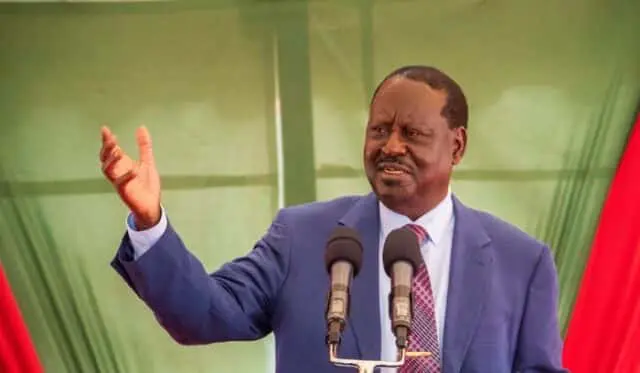
President Uhuru Kenyatta is reportedly unhappy with his ‘handshake brother’, ODM leader Raila Odinga, over his push for constitutional changes.
Sources in the presidency told the Star that Raila’s insistence on a referendum is causing jitters that could undermine the celebrated handshake, less than three months old.
Confidential sources say Uhuru believes that Raila’s proposal is undermining their unity pact. This concern arises even before a committee formed to drive its agenda reports back.
The steering committee led by lawyer Paul Mwangi and ambassador Martin Kimani met last week in Naivasha. They convened to draw up its terms of reference and programme of action.
“The advisers expect to travel to different parts of the country. They aim to engage with different audiences in the coming days and weeks,” it said in a statement last week.
Uhuru is said to be concerned that the calls for constitutional amendments are polarising rather than uniting the country. Uniting the country was the objective of their handshake on March 9.
He has repeatedly told his advisers that he does not want politics to obstruct his Big Four legacy agenda. This agenda includes food security, affordable housing, universal healthcare and manufacturing.
According to reliable sources within the presidency, Uhuru had shunned the ongoing debate on a referendum. He aimed to avoid being seen as violating the spirit of the handshake.
He has fought off pressure from his allies to speak out against Raila’s drive for constitutional reforms, which has faced strident opposition from a wing of his party.
“President Kenyatta was mute on the clamour for amendment of the laws. If he speaks openly against it, he puts the handshake in jeopardy,” one trusted source said.
“Every signature project in the first term was subject to endless litigation. A plethora of injunctions threatened to scare investors away due to instability occasioned by violence,” the source added.
But last week, the President broke his silence. He sent a blunt message to Raila and those supporting his call for a referendum.
While addressing the private sector on partnership opportunities with the government on the Big Four agenda, Uhuru made clear where his focus lies.
“I have no time to run around telling people to change the Constitution. It won’t solve the problems we have. Engaging with the private sector on manufacturing will,” Uhuru said on Friday last week (May 18).
It was the first time that Uhuru was speaking out on the proposed changes. Previously, he had only hinted at them in his speeches.
“It is important to emphasize that unity doesn’t mean unanimity,” the President had said during the State of the Nation address on May 2.
His statement on Friday appeared triggered by the crescendo of agitation for and against constitutional amendments. There were also fears among the business community that the country was returning to political contests.
CAUTIOUS
Yesterday, insiders told the Star that despite the handshake, the President appears to be cautious about Raila. There is apprehension within his Jubilee Party that the NASA leader could be driving his own agenda, potentially wrecking the party.
A meeting of Uhuru’s trusted aides held mid-last week to evaluate the handshake. It concluded that the handshake had aided Raila’s political career.
It concluded that the only way to safeguard the President’s intentions in the handshake, as well as his legacy, is to clip the clamour for constitutional change. The mission has been left to Deputy President William Ruto to prosecute, as the President stays off the subject.
Ruto has taken it upon himself to fight what is perceived as Raila’s attempt to reposition himself and grab power.
“Lazy and incompetent people who don’t want to work hard, and those who can’t formulate programmes use the Constitution as their bogeyman,” Ruto said at the Legislative Summit in Mombasa on Tuesday.
Ruto’s allies are suspicious that Raila wants to use the clamor for constitutional change to reinvent himself. They believe he intends to consolidate support in several regions.
Raila ran afoul of Ruto. Ruto had initially voiced cautious support for the handshake. This changed when Raila proposed the country consider introducing three levels of government during the National Devolution Conference in Kakamega.
“As a matter of lasting solution to the problem posed by sizes of devolved units, we need to revisit the structure of devolution,” Raila said on April 25.
He called for the Bomas Draft that divided Kenya into 14 regions. “It is time to look at how to recover this original spirit… my proposal is we adopt a three-tier system of government,” he said.
RESISTANCE
The proposal met immediate resistance from Ruto, among other Jubilee politicians. However, it added fuel to the debate on creating the position of Prime Minister and deputies to dilute Executive power.
A week later, while addressing his ODM party top brass in Naivasha, Raila said constitutional reform was inevitable. He believed it was key to achieving the objectives of the unity deal he had signed with Uhuru.
That triggered the polarising debate on constitutional amendments, which has turned into a vicious brawl between Raila and Ruto allies.
Some sitting governors who are uncomfortable with the proposal are said to have reached out to the presidency to help stall the momentum of Raila’s proposal.
“Tinga will be keen to reward his staunch allies who are on their way out after serving a second term as governors. These people are most likely to take up the new regional governments that he has proposed,” a Jubilee insider said.
Jubilee stalwarts insist the unity deal between Uhuru and Raila had nothing to do with changing any laws.
Vocal Gatundu North MP Moses Kuria argued that the country cannot go to a referendum just to create executive positions for people.
“A referendum will put us in a politicking mood and [provide] an opportunity to hurl insults at one another. Meanwhile, critical issues like hospitals, colleges, and roads take a back seat,” the MP told the Star.
Despite the vigorous debate, there are many initiatives to amend the constitution already underway. Ekuru Aukot’s Thirdway Alliance has been given the green light by the electoral body to commence the process of collecting one million signatures with a view to amend the Constitution and reduce the number of elected representatives.
There is also a petition by Tiaty MP William Kamket to introduce the position of Prime Minister with executive powers and a ceremonial President.
By OLIVER MATHENGE